
Mstislav Rostropovich
Cellist who expanded the repertoire and championed human rights.

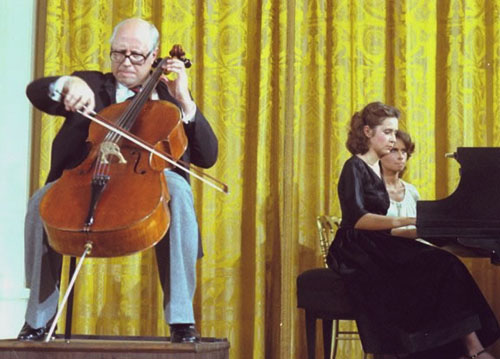
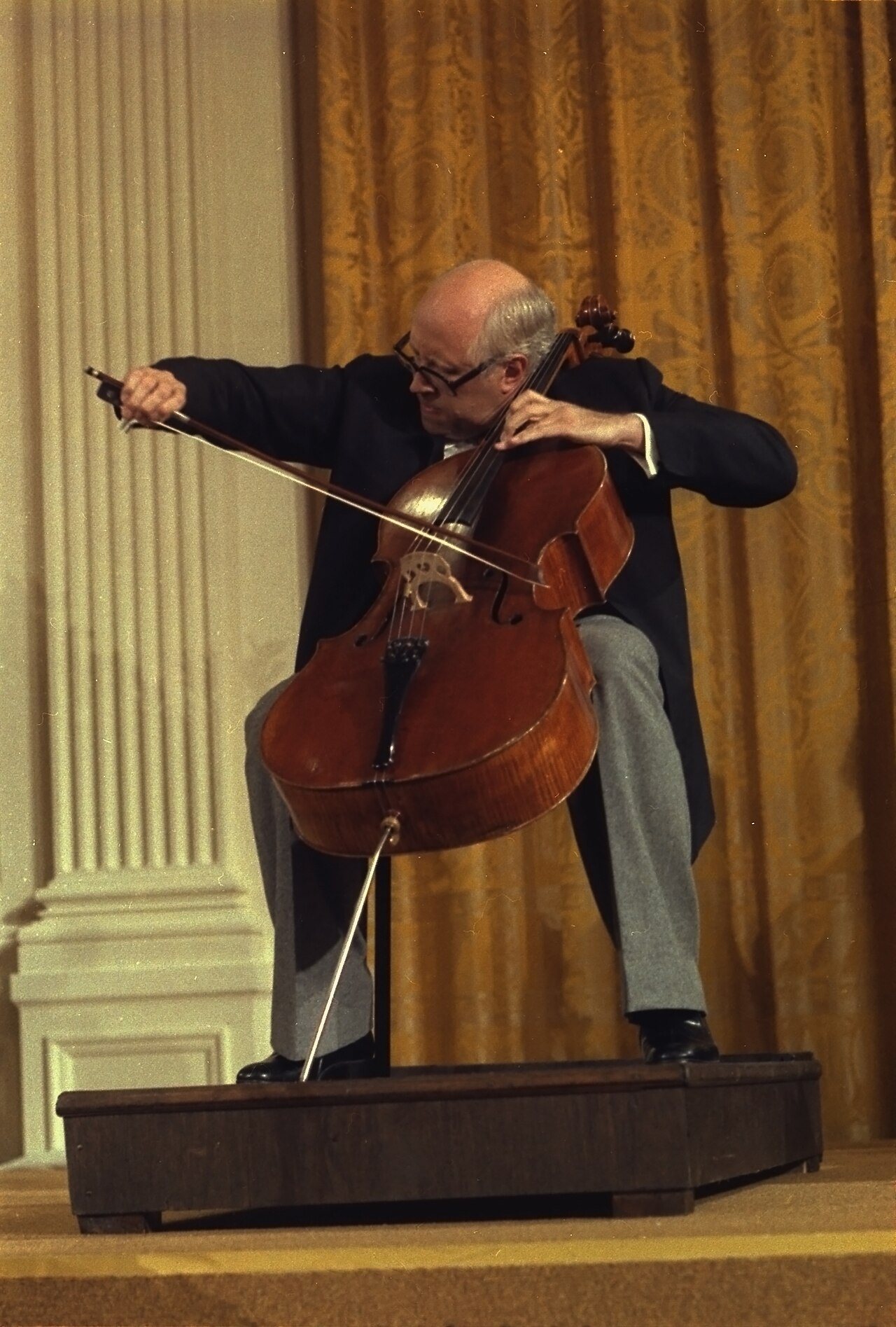
White House Staff Photographers · Public domain
Mstislav Leopoldovich Rostropovich (27 March 1927 – 27 April 2007) was a Soviet and Russian cellist and conductor. In addition to his interpretations and technique, he was well known for both inspiring and commissioning new works, which enlarged the cello repertoire more than any cellist before or since. He inspired and premiered over 100 pieces, forming long-standing friendships and artistic partnerships with composers including Dmitri Shostakovich, Sergei Prokofiev, Nikolai Myaskovsky, Henri Dutilleux, Witold Lutosławski, Olivier Messiaen, Luciano Berio, Krzysztof Penderecki, Alfred Schnittke, Norbert Moret, Andreas Makris, Leonard Bernstein, Aram Khachaturian, and Benjamin Britten. Rostropovich was internationally recognized as a staunch advocate of human rights, and was awarded the 1974 Award of the International League of Human Rights.
- born
- 27 March 1927, Baku, Azerbaijan SSR
- died
- 27 April 2007
- field
- Cellist, conductor
- nationality
- Soviet and Russian
- known_for
- Inspiring and commissioning new works for cello; human rights advocacy
Verified Timeline
Lore & Background
Rostropovich was born in Baku, Azerbaijan SSR, to parents who had moved from Orenburg in Russia: Leopold Vitoldovich Rostropovich, a renowned cellist and former student of Pablo Casals, and Sofiya Nikolaevna Fedotova-Rostropovich, a talented pianist. At age four, he began studying piano with his mother, and at age eight, began learning the cello from his father. In 1943, at age 16, he entered the Moscow Conservatory, where he studied cello with his uncle Semyon Kozolupov, piano with Nikolai Kuvshinnikov, and composition with Vissarion Shebalin. His teachers also included Dmitri Shostakovich. In 1945, he came to prominence as a cellist when he won the gold medal in the Soviet Union's first ever competition for young musicians. He graduated from the Conservatory in 1948 and became professor of cello there in 1956. He married soprano Galina Vishnevskaya in 1955. Rostropovich had working relationships with Soviet composers: Nikolai Myaskovsky dedicated his Cello Sonata no. 2, Op. 81, to him; Sergei Prokofiev wrote his Cello Sonata, Op. 119, and Symphony-Concerto for him; Dmitri Shostakovich wrote both his first and second cello concertos for him. Benjamin Britten dedicated his Cello Sonata, three Solo Suites, and his Cello Symphony to Rostropovich. At The Proms on 21 August 1968, he played Dvořák's Cello Concerto in B minor with the USSR State Symphony Orchestra on the same day the Warsaw Pact invaded Czechoslovakia. After the performance, Rostropovich stood and held aloft the conductor's score of the Dvořák as a gesture of solidarity for the composer's homeland and the city of Prague. In 1970, Rostropovich sheltered Aleksandr Solzhenitsyn in his own home. His friendship with Solzhenitsyn and support for dissidents led to official disgrace in the early 1970s. He left the Soviet Union in 1974 with his wife and children and settled in the United States. In 1978, Rostropovich was deprived of his Soviet citizenship because of his public opposition to the Soviet Union's restriction of cultural freedom. He did not return to the Soviet Union until 1990.
Reader's Guide
Rostropovich's significance lies in his dual legacy as a performer and a catalyst for new music. He inspired and premiered over 100 pieces, working with major 20th-century composers to create enduring works for cello. His advocacy for human rights, including his support for dissidents and his protest against the invasion of Czechoslovakia, made him a symbol of artistic freedom. Despite harassment and exile from the Soviet Union, he continued his career as a conductor and performer, notably leading the National Symphony Orchestra in Washington, D.C. from 1977 to 1994. His efforts to aid Armenian earthquake victims in 1988—including a special concert at Barbican Hall on 17 December 1988, part of an effort called Musicians for Armenia expected to raise more than $450,000—further demonstrated his humanitarian commitment. Rostropovich's impact on the cello repertoire and his moral stance remain central to his legacy.
Did You Know?
- Rostropovich won the gold medal in the Soviet Union's first ever competition for young musicians in 1945.
- He was awarded the 1974 Award of the International League of Human Rights.
- At The Proms on 21 August 1968, he held aloft the conductor's score of Dvořák's Cello Concerto as a gesture of solidarity with Prague after the Warsaw Pact invasion.
- He sheltered Aleksandr Solzhenitsyn in his own home in 1970.
- Rostropovich was deprived of his Soviet citizenship in 1978 and did not return until 1990.
A Catalyst for New Music
Rostropovich's most enduring contribution to the cello world was not merely his virtuoso interpretations but his extraordinary ability to draw new music into existence. Over his career, he inspired and premiered more than one hundred works, a number that no other cellist has matched before or since. His relationships with composers were deeply personal and long-lasting. Shostakovich turned to Rostropovich as the dedicatee and first interpreter of both his cello concertos. Prokofiev, moved by a 1949 sonata performance, composed his Op. 119 Cello Sonata and the Symphony-Concerto, both premiered by Rostropovich; after Prokofiev's death, Rostropovich and Dmitry Kabalevsky completed the composer's Cello Concertino. In the West, Benjamin Britten dedicated his Cello Sonata, three Solo Suites, and Cello Symphony to him. He also formed creative bonds with Dutilleux, Lutosławski, Penderecki, Berio, Messiaen, and Myaskovsky, the latter of whom dedicated his Cello Sonata No. 2 to Rostropovich, and they premiered it together in 1949. These partnerships transformed the cello from a largely historical instrument into a living voice of modern composition.
Roots in Baku and a Musical Dynasty
Born in March 1927 in Baku, Azerbaijan, Mstislav Rostropovich entered a world saturated with music from the very start. His father, Leopold, was a celebrated cellist and former pupil of Pablo Casals, while his mother, Sofiya, was a conservatory-trained pianist of Russian descent. The family's heritage stretched back through Polish nobility bearing the Bogoria coat of arms, German and Huguenot ancestry, and distant Belarusian roots. Rostropovich began piano lessons with his mother at age four and picked up the cello at eight under his father's guidance. During the war, the family relocated to Orenburg and then Moscow in 1943, where the sixteen-year-old entered the Moscow Conservatory. There he studied cello with his uncle Semyon Kozolupov, piano with Kuvshinnikov, composition with Shebalin, and also received instruction from Shostakovich. In 1945 he captured the gold medal at the Soviet Union's inaugural competition for young musicians, and by 1950, at twenty-three, he had been awarded the Stalin Prize, the country's highest honor at the time.
The Proms, Prague, and a Stand for Freedom
The night of 21 August 1968 at the BBC Proms remains one of the most charged moments in Rostropovich's public life. He performed Dvořák's Cello Concerto in B minor with the USSR State Symphony Orchestra, marking the ensemble's debut at the festival. The concert took place on the very day the Warsaw Pact armies rolled into Czechoslovakia to crush Alexander Dubček's Prague Spring reforms. The hall had been disrupted by heckling and demonstrations before the music began, yet once the performance concluded, the audience rose to cheer both soloist and orchestra. In a gesture that transcended the concert stage, Rostropovich stood and lifted the conductor's score of the Dvořák high above his head, a silent act of solidarity with the composer's homeland and the besieged city of Prague. This moment crystallized his broader identity as a human rights advocate. He had long championed artistic freedom and democratic values, drawing the ire of Soviet authorities. In 1974 he received the Award of the International League of Human Rights, a recognition of his sustained commitment to principles the regime sought to suppress.
Beyond the Cello: Conducting, Family, and Legacy
While the cello defined his public image, Rostropovich also cultivated a serious conducting career. He took private lessons with Leo Ginzburg and made his public conducting debut in Gorky in November 1962, presenting Shostakovich's orchestration of Mussorgsky's Songs and Dances of Death alongside Vishnevskaya's singing. In 1967, at the invitation of Bolshoi director Mikhail Chulaki, he conducted Tchaikovsky's Eugene Onegin at the Bolshoi. His personal life was inseparable from his art: he married the Bolshoi soprano Galina Vishnevskaya in 1955, and together they raised two daughters, Olga and Elena. His family spoke of a special tenderness in his bond with Britten, describing him as always smiling when discussing Ben, and on his deathbed in April 2007 he reportedly expressed no fear, believing he and Britten would be reunited in Heaven. His daughter recalled that a recording of Schubert's Arpeggione Sonata made with Britten moved her father to tears of joy even in his final hours. Among his many honors was the Polar Music Prize, a testament to a life bridging performance, composition, advocacy, and deep human connection.
Gallery
Frequently Asked Questions
Who is Mstislav Rostropovich?
He was a Soviet and Russian cellist and conductor born in Baku in 1927, widely regarded as one of the most influential figures in 20th-century classical music. He passed away in April 2007.
Why is Rostropovich considered so pivotal to the cello repertoire?
He inspired and premiered more than 100 new works for the instrument, broadening its literature to a degree no other cellist has matched. Composers of the 20th century frequently wrote specifically for him, knowing his technical range and expressive depth would bring their visions to life.
What was Rostropovich's role in human rights advocacy?
He used his international platform to speak out for political prisoners and civil liberties, which ultimately led to his forced exile from the Soviet Union. His activism made him a widely recognized symbol of artistic resistance behind the Iron Curtain.
How did Rostropovich collaborate with composers?
He actively commissioned and premiered new cello pieces, serving as both interpreter and creative catalyst for over 100 works. His deep musical partnership with composers meant he often shaped pieces from the earliest sketches through to their public debut.
Where was Rostropovich born and what was his nationality?
He was born on 27 March 1927 in Baku, Azerbaijan SSR, and held Soviet and Russian nationality throughout his life. He died on 27 April 2007.
More in Musicians & Composers 1-19
Related in Musicians & Composers
Links follow this subject's own source article.
Spotted an error? Know more?
This is a living reference — every entry is fact-audited, and reader corrections feed straight into our audit queue. Suggest an edit · See this site's audit record